
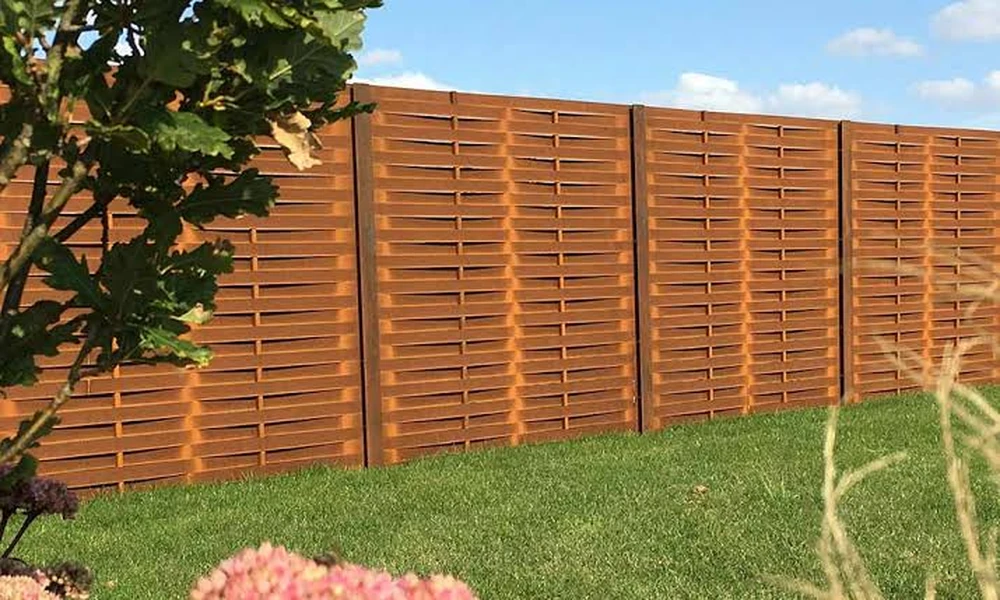
One of the appealing things about buying a new-build home is that everything is supposed to be new. Fresh turf, clean paving, newly planted borders and a straight fence can make the garden look completely finished on moving day. But new garden fencing is only as good as the ground and installation supporting it, and the first few years of a new development can reveal problems that weren’t visible when the keys changed hands.
That doesn’t mean there is something inherently wrong with fencing on new housing estates.
Plenty is installed perfectly well.
The problem is that a newly created garden is a very different environment from an established one.
Ground has been excavated, machinery has moved across it, services have been installed and levels may have changed considerably during construction. Soil can be compacted in one area and recently filled in another. Drainage patterns are still becoming apparent.
Then somebody installs a boundary through it.
A perfectly straight fence on completion day tells you very little about how it will look three winters later.
New houses don’t necessarily mean settled ground
On an established property, the ground around the garden may have been largely undisturbed for decades.
New development is different.
Before the garden exists, the site may have seen foundations excavated, drainage installed, trenches dug for utilities, access created for heavy equipment and significant quantities of soil moved around.
That matters to fencing because posts depend on stable ground.
One post might be installed into relatively undisturbed soil while the next sits where a trench has previously been backfilled. Another could encounter buried rubble or heavily compacted material.
From above, none of this is obvious.
The garden gets levelled, turf goes down and everything looks remarkably neat.
It is only later that settlement can reveal differences underneath.
This is why I wouldn’t immediately assume that a slightly moving fence on a relatively new property means the panels themselves are poor quality. The first question should be what is happening at the posts and below ground.
Drainage often tells the bigger story
If I were looking at the garden of a recently built house, one of the first things I’d want to know is where the water goes.
Stand outside after sustained rain rather than on a dry afternoon.
Does water disappear reasonably quickly?
Does it collect along the rear boundary?
Is one corner consistently wet?
Does water run towards the fence from neighbouring gardens?
Standing water around posts is never particularly desirable, especially with timber.
A post doesn’t necessarily rot because it got wet once. The bigger issue is repeated exposure to moisture and conditions that prevent timber from drying properly.
The area around ground level deserves particular attention because this is frequently where timber posts deteriorate first.
I’ve removed posts that looked completely acceptable above ground but had lost a substantial amount of material around the base.
New gardens can make this harder to spot because everything surrounding the fence still looks tidy.
The smallest plots can create surprisingly demanding boundaries
Modern housing layouts often make efficient use of available land.
That can mean houses, parking spaces, gardens, paths and neighbouring properties sitting relatively close together.
For the fence, this changes the job.
A boundary might need to provide privacy from a neighbouring patio only a few metres away. Another section could separate a garden from parking. A side gate may be one of the main security barriers between the front of the property and the back door.
The fence is no longer simply something running around the edge of a large garden.
It is performing several jobs in a relatively compact space.
That can tempt people to immediately make boundaries taller or more solid, particularly where neighbouring windows overlook the garden.
I would think carefully before doing that.
Increasing the height and solidity of a fence changes how it behaves in the wind. It can affect light. It can make a small garden feel enclosed. There can also be planning and boundary considerations depending on where the fence is positioned.
Privacy matters, but maximum height isn’t automatically the best solution.
Exposed development edges deserve extra attention
There is another characteristic of newer estates that often gets overlooked.
The houses on the outer edge can be remarkably exposed.
A garden that backs onto open land experiences different wind conditions from one surrounded on every side by established buildings, mature trees and other boundaries.
As further phases of a development are constructed, those conditions can change again.
This is particularly relevant around parts of Barnsley where residential areas meet fields and more open countryside.
Solid fence panels catch wind.
The larger the uninterrupted surface, the more force gets transferred into the supporting structure. If the posts are substantial and properly installed, that has been accounted for. If corners were cut below ground, strong weather tends to expose them.
This is one reason I dislike judging fencing purely by the visible materials.
People will spend considerable time choosing the colour and style of a panel but may never ask how deep the posts are going.
I’d take properly installed ordinary fencing over expensive panels supported badly every time.
A dropped gate is worth investigating
One of the earliest signs of movement can be a gate that stops behaving properly.
It may start rubbing against the ground.
The latch may need lifting slightly before it engages.
A gap that was even when you moved in may become noticeably wider at the top or bottom.
The temptation is to adjust the hinges.
Sometimes that is exactly what is required. Gates themselves can settle, fixings can need attention and timber can move.
But check the supporting posts first.
If the post has moved, adjusting the gate around it can disguise the problem without solving it.
A useful trick is to stand several metres away and look at the entire opening rather than concentrating on the hinge.
Does the gate itself appear to have dropped diagonally?
Is one post leaning?
Has the gap between the two posts changed?
If the opening has moved, the problem is bigger than a latch.
The same principle applies to heavier garden and driveway gates. More weight means greater demands on the supporting structure, so the foundations and posts matter at least as much as the gate itself.
Don’t assume every boundary belongs entirely to you
This is less exciting than discussing posts and concrete, but it can save an enormous amount of aggravation.
Before replacing, raising or significantly altering a fence on a relatively new development, establish what you’re actually entitled to change.
Check the property documents.
Do not rely entirely on the idea that the fence on a particular side is automatically yours because somebody once told you that every homeowner owns the left-hand boundary, or the right-hand one.
There isn’t a universal rule like that.
New developments can also have covenants or other restrictions affecting alterations.
If you’re unsure, find out before paying somebody to remove anything.
A technically excellent fence in the wrong place can become a very expensive problem.
Don’t confuse cheap panels with the whole problem
Fence panels get blamed for almost everything because they are the part people can see.
A panel comes loose and the panel must be rubbish.
A section leans and the panels must need replacing.
Not necessarily.
I’ve seen inexpensive panels remain serviceable because the supporting structure was sound. I’ve also seen much better-quality materials fail prematurely because the installation underneath them wasn’t adequate.
Look at the system rather than one component.
Posts support rails or panels. Footings support posts. Gravel boards keep appropriate timber components away from direct ground contact. Fixings hold everything together. Gates introduce moving loads.
Weakness in one part affects the others.
This is particularly important if you’re considering replacing developer-installed fencing shortly after moving in. You need to know whether you’re replacing the thing that failed or simply the thing that looks damaged.
Those aren’t always the same thing.
Repair can be perfectly sensible on a young fence
A fence doesn’t become a write-off because one section has moved.
If the majority of the installation is sound and one post has developed a problem, a targeted fence repair may be all that is required.
I’d be more concerned about patterns.
Several posts leaning in the same direction deserve investigation.
Repeated movement along one boundary suggests something more systematic.
Multiple failed footings on relatively young fencing would make me question the original installation rather than treating each one as an isolated accident.
Likewise, if water constantly sits along the entire boundary, replacing damaged timber without addressing the surrounding conditions may simply restart the clock.
A good repair should deal with the reason something failed, not merely restore the appearance.
Give a new garden time before redesigning every boundary
Moving into a new house creates a strong urge to change things.
The garden can feel particularly unfinished because it often lacks the mature planting and character of an older property.
I’d resist making every fencing decision immediately.
Live with the garden through different weather.
See where the evening sun actually falls in June rather than guessing in November. Notice which areas feel overlooked when neighbours are using their gardens. See where water collects after sustained rain. Pay attention to the direction strong winds come from.
You may discover that the boundary you planned to make completely solid benefits from allowing more light through the top.
You might find that privacy only matters around the seating area rather than across the entire garden.
A gate might be more useful in a different position.
These are easier decisions to make after you’ve actually used the space.
New doesn’t mean maintenance-free
There is a wider assumption with new-build properties that because everything is new, nothing should need attention for years.
Gardens don’t really work like that.
Plants grow. Soil settles. Timber weathers. Drainage reveals itself. Neighbouring properties change. Trees and shrubs begin affecting boundaries that initially had nothing around them.
The first few years tell you a lot about how a garden works.
Fencing is part of that.
Keep vegetation from placing unnecessary pressure against panels. Check gates if they begin catching. Look at posts after prolonged wet weather. Pay attention to movement rather than waiting until something actually falls.
Most importantly, don’t panic because a new fence develops one problem.
Find the cause first.
I’ve never considered the best fence to be the one that looks most impressive on the day it is installed. I am far more interested in the one that still looks boringly straight after the garden, ground and Yorkshire weather have had several years to test it.
One of the appealing things about buying a new-build home is that everything is supposed to be new. Fresh turf, clean paving, newly planted borders and a straight fence can make the garden look completely finished on moving day. But new garden fencing is only as good as the ground and installation supporting it, and the first few years of a new development can reveal problems that weren’t visible when the keys changed hands.
That doesn’t mean there is something inherently wrong with fencing on new housing estates.
Plenty is installed perfectly well.
The problem is that a newly created garden is a very different environment from an established one.
Ground has been excavated, machinery has moved across it, services have been installed and levels may have changed considerably during construction. Soil can be compacted in one area and recently filled in another. Drainage patterns are still becoming apparent.
Then somebody installs a boundary through it.
A perfectly straight fence on completion day tells you very little about how it will look three winters later.
New houses don’t necessarily mean settled ground
On an established property, the ground around the garden may have been largely undisturbed for decades.
New development is different.
Before the garden exists, the site may have seen foundations excavated, drainage installed, trenches dug for utilities, access created for heavy equipment and significant quantities of soil moved around.
That matters to fencing because posts depend on stable ground.
One post might be installed into relatively undisturbed soil while the next sits where a trench has previously been backfilled. Another could encounter buried rubble or heavily compacted material.
From above, none of this is obvious.
The garden gets levelled, turf goes down and everything looks remarkably neat.
It is only later that settlement can reveal differences underneath.
This is why I wouldn’t immediately assume that a slightly moving fence on a relatively new property means the panels themselves are poor quality. The first question should be what is happening at the posts and below ground.
Drainage often tells the bigger story
If I were looking at the garden of a recently built house, one of the first things I’d want to know is where the water goes.
Stand outside after sustained rain rather than on a dry afternoon.
Does water disappear reasonably quickly?
Does it collect along the rear boundary?
Is one corner consistently wet?
Does water run towards the fence from neighbouring gardens?
Standing water around posts is never particularly desirable, especially with timber.
A post doesn’t necessarily rot because it got wet once. The bigger issue is repeated exposure to moisture and conditions that prevent timber from drying properly.
The area around ground level deserves particular attention because this is frequently where timber posts deteriorate first.
I’ve removed posts that looked completely acceptable above ground but had lost a substantial amount of material around the base.
New gardens can make this harder to spot because everything surrounding the fence still looks tidy.
The smallest plots can create surprisingly demanding boundaries
Modern housing layouts often make efficient use of available land.
That can mean houses, parking spaces, gardens, paths and neighbouring properties sitting relatively close together.
For the fence, this changes the job.
A boundary might need to provide privacy from a neighbouring patio only a few metres away. Another section could separate a garden from parking. A side gate may be one of the main security barriers between the front of the property and the back door.
The fence is no longer simply something running around the edge of a large garden.
It is performing several jobs in a relatively compact space.
That can tempt people to immediately make boundaries taller or more solid, particularly where neighbouring windows overlook the garden.
I would think carefully before doing that.
Increasing the height and solidity of a fence changes how it behaves in the wind. It can affect light. It can make a small garden feel enclosed. There can also be planning and boundary considerations depending on where the fence is positioned.
Privacy matters, but maximum height isn’t automatically the best solution.
Exposed development edges deserve extra attention
There is another characteristic of newer estates that often gets overlooked.
The houses on the outer edge can be remarkably exposed.
A garden that backs onto open land experiences different wind conditions from one surrounded on every side by established buildings, mature trees and other boundaries.
As further phases of a development are constructed, those conditions can change again.
This is particularly relevant around parts of Barnsley where residential areas meet fields and more open countryside.
Solid fence panels catch wind.
The larger the uninterrupted surface, the more force gets transferred into the supporting structure. If the posts are substantial and properly installed, that has been accounted for. If corners were cut below ground, strong weather tends to expose them.
This is one reason I dislike judging fencing purely by the visible materials.
People will spend considerable time choosing the colour and style of a panel but may never ask how deep the posts are going.
I’d take properly installed ordinary fencing over expensive panels supported badly every time.
A dropped gate is worth investigating
One of the earliest signs of movement can be a gate that stops behaving properly.
It may start rubbing against the ground.
The latch may need lifting slightly before it engages.
A gap that was even when you moved in may become noticeably wider at the top or bottom.
The temptation is to adjust the hinges.
Sometimes that is exactly what is required. Gates themselves can settle, fixings can need attention and timber can move.
But check the supporting posts first.
If the post has moved, adjusting the gate around it can disguise the problem without solving it.
A useful trick is to stand several metres away and look at the entire opening rather than concentrating on the hinge.
Does the gate itself appear to have dropped diagonally?
Is one post leaning?
Has the gap between the two posts changed?
If the opening has moved, the problem is bigger than a latch.
The same principle applies to heavier garden and driveway gates. More weight means greater demands on the supporting structure, so the foundations and posts matter at least as much as the gate itself.
Don’t assume every boundary belongs entirely to you
This is less exciting than discussing posts and concrete, but it can save an enormous amount of aggravation.
Before replacing, raising or significantly altering a fence on a relatively new development, establish what you’re actually entitled to change.
Check the property documents.
Do not rely entirely on the idea that the fence on a particular side is automatically yours because somebody once told you that every homeowner owns the left-hand boundary, or the right-hand one.
There isn’t a universal rule like that.
New developments can also have covenants or other restrictions affecting alterations.
If you’re unsure, find out before paying somebody to remove anything.
A technically excellent fence in the wrong place can become a very expensive problem.
Don’t confuse cheap panels with the whole problem
Fence panels get blamed for almost everything because they are the part people can see.
A panel comes loose and the panel must be rubbish.
A section leans and the panels must need replacing.
Not necessarily.
I’ve seen inexpensive panels remain serviceable because the supporting structure was sound. I’ve also seen much better-quality materials fail prematurely because the installation underneath them wasn’t adequate.
Look at the system rather than one component.
Posts support rails or panels. Footings support posts. Gravel boards keep appropriate timber components away from direct ground contact. Fixings hold everything together. Gates introduce moving loads.
Weakness in one part affects the others.
This is particularly important if you’re considering replacing developer-installed fencing shortly after moving in. You need to know whether you’re replacing the thing that failed or simply the thing that looks damaged.
Those aren’t always the same thing.
Repair can be perfectly sensible on a young fence
A fence doesn’t become a write-off because one section has moved.
If the majority of the installation is sound and one post has developed a problem, a targeted fence repair may be all that is required.
I’d be more concerned about patterns.
Several posts leaning in the same direction deserve investigation.
Repeated movement along one boundary suggests something more systematic.
Multiple failed footings on relatively young fencing would make me question the original installation rather than treating each one as an isolated accident.
Likewise, if water constantly sits along the entire boundary, replacing damaged timber without addressing the surrounding conditions may simply restart the clock.
A good repair should deal with the reason something failed, not merely restore the appearance.
Give a new garden time before redesigning every boundary
Moving into a new house creates a strong urge to change things.
The garden can feel particularly unfinished because it often lacks the mature planting and character of an older property.
I’d resist making every fencing decision immediately.
Live with the garden through different weather.
See where the evening sun actually falls in June rather than guessing in November. Notice which areas feel overlooked when neighbours are using their gardens. See where water collects after sustained rain. Pay attention to the direction strong winds come from.
You may discover that the boundary you planned to make completely solid benefits from allowing more light through the top.
You might find that privacy only matters around the seating area rather than across the entire garden.
A gate might be more useful in a different position.
These are easier decisions to make after you’ve actually used the space.
New doesn’t mean maintenance-free
There is a wider assumption with new-build properties that because everything is new, nothing should need attention for years.
Gardens don’t really work like that.
Plants grow. Soil settles. Timber weathers. Drainage reveals itself. Neighbouring properties change. Trees and shrubs begin affecting boundaries that initially had nothing around them.
The first few years tell you a lot about how a garden works.
Fencing is part of that.
Keep vegetation from placing unnecessary pressure against panels. Check gates if they begin catching. Look at posts after prolonged wet weather. Pay attention to movement rather than waiting until something actually falls.
Most importantly, don’t panic because a new fence develops one problem.
Find the cause first.
I’ve never considered the best fence to be the one that looks most impressive on the day it is installed. I am far more interested in the one that still looks boringly straight after the garden, ground and Yorkshire weather have had several years to test it.